Closed-loop evaluation with MuJoCo simulation
Before real-robot operation, use a tabletop manipulation simulator to closed-loop verify the ACT inference pipeline and alignment accuracy.
Dependency setup (host)
source .venv/bin/activate
pip install -e "port_pick_align/[simulation,dev]"
# Also install the training extra when inferring from a trained checkpoint
pip install -e "port_pick_align/[simulation,training,dev]"
Offscreen rendering works with a normal python interpreter (mjpython is only needed for the interactive 3D viewer). In environments that require an explicit graphics backend, set:
Simulation environment
- Mechanism: 6-DoF arm and gripper (joint names match
configs/contract.yaml) - Sensors: Top and Wrist dual cameras (640×480)
- Objects: small rectangular box and a tabletop alignment target frame
- Package:
port_pick_align.simulation(model:simulation/assets/so101_tabletop.xml)
Table layout (2026-10-26 source of truth)
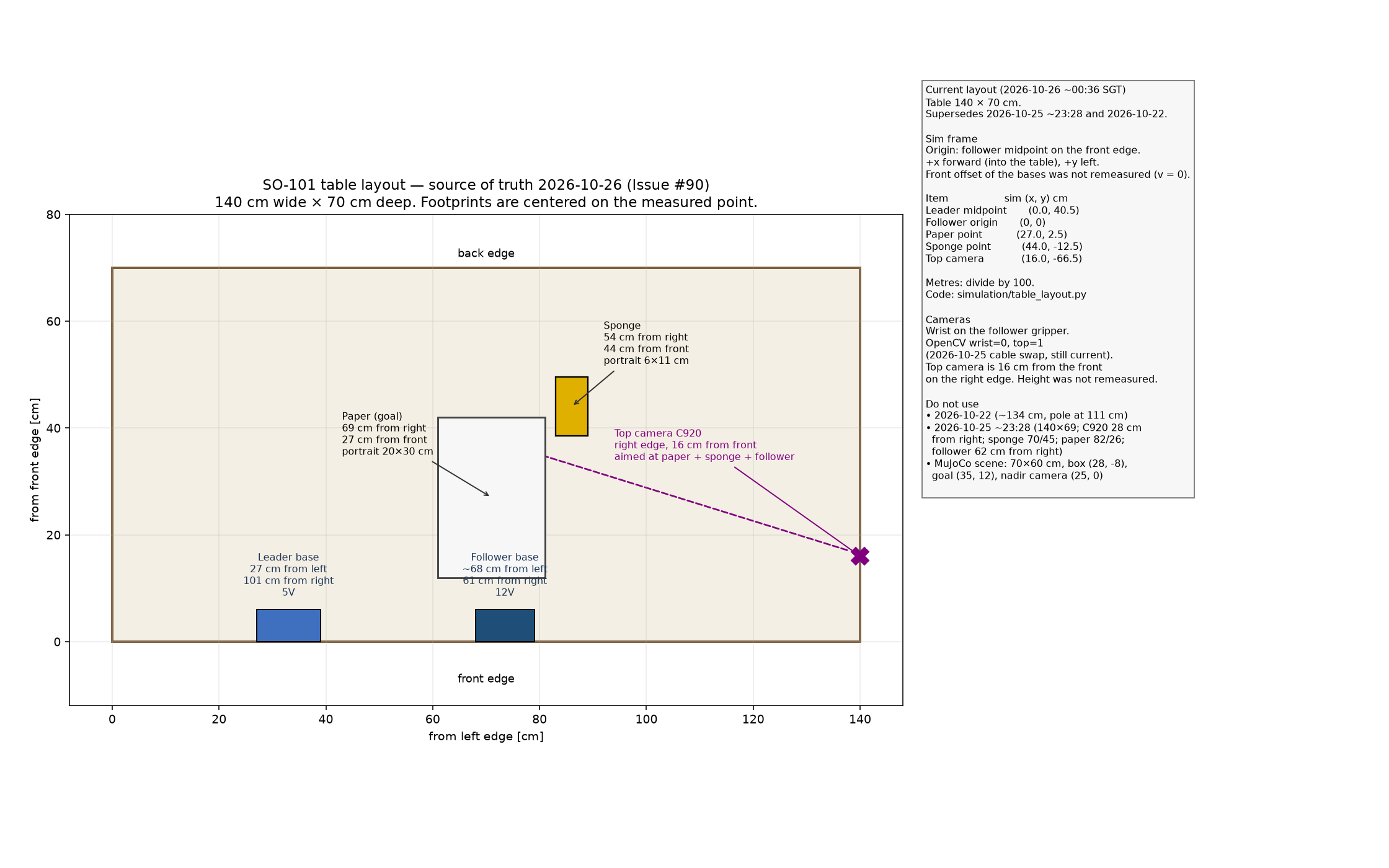
Real bring-up and live eval use the standardized table layout (140 × 70 cm): leader 27 cm from the left / 101 cm from the right, follower ~68 cm from the left / 61 cm from the right, C920 on the right edge 16 cm from the front, paper 69 cm from the right and 27 cm from the front (portrait 20×30 cm), sponge 54 cm from the right and 44 cm from the front (portrait 6×11 cm). Wrist camera on the follower gripper. OpenCV wrist 0, top 1.
Those edge measurements map into the sim frame (follower midpoint on the front edge, +x forward, +y left) as:
| Item | Sim (x, y) m |
|---|---|
| Leader midpoint | (0, 0.405) |
| Follower origin | (0, 0) |
| Paper point | (0.27, 0.025) |
| Sponge point | (0.44, −0.125) |
| Top camera | (0.16, −0.665) |
The map and the conventions behind it (base midpoint, front-edge origin, measured point rather than a stated corner) are in table_layout.py and hardware.md.
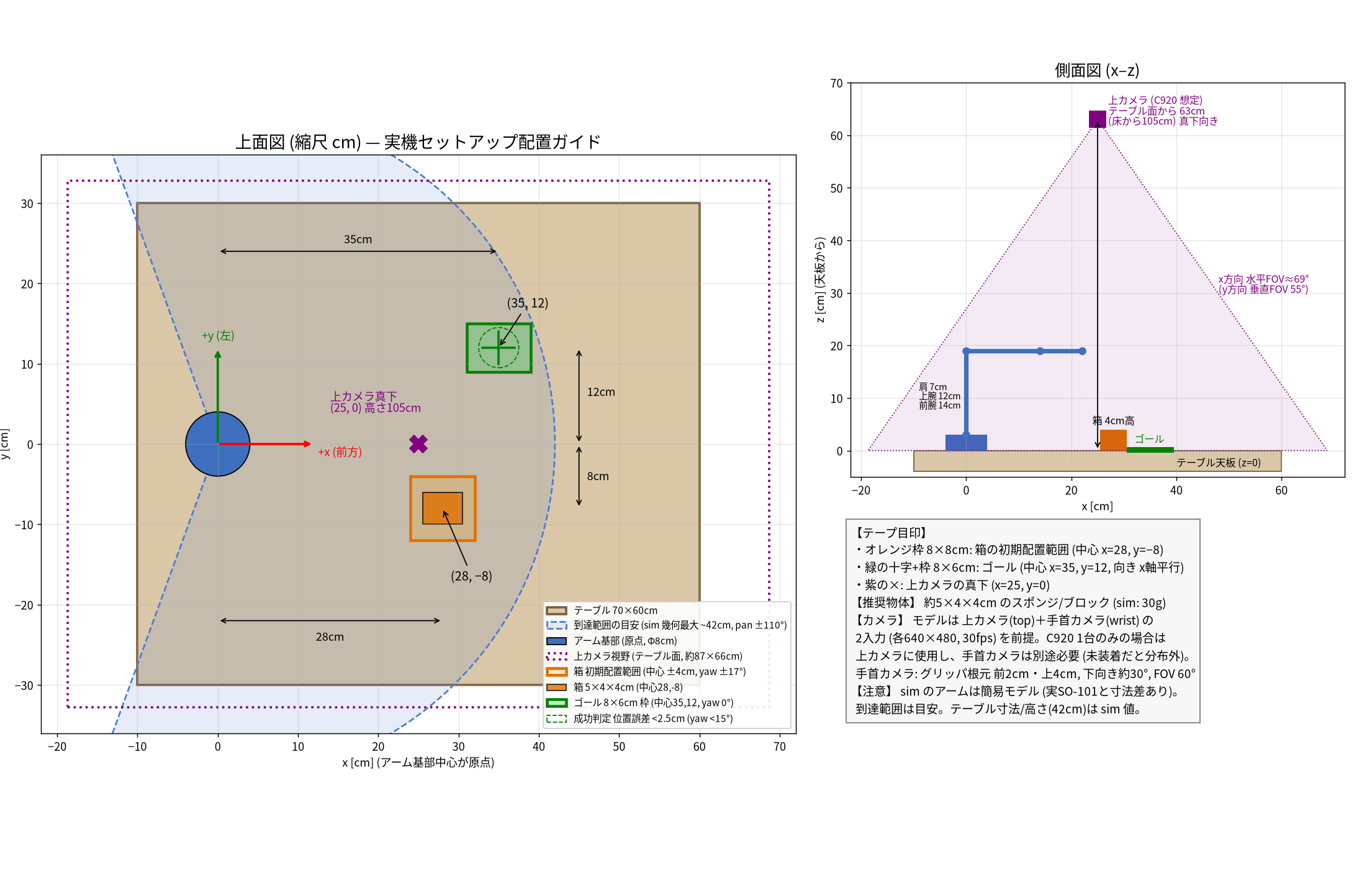
so101_tabletop.xml still loads the superseded simplified scene: table about 70×60 cm, box spawn (0.28, -0.08) m, goal (0.35, 0.12) m, nadir top camera (0.25, 0, 1.05) m. Current sim eval uses that scene so existing checkpoints stay comparable. Do not copy those geoms into bring-up. The old figure is so101_layout_guide_superseded_pre_20261026.png. The current figure is so101_layout_guide.png. Also superseded, and not in the XML: the 2026-10-25 ~23:28 measurements (table 140×69, C920 28 cm from the right, sponge 70/45, paper 82/26, follower 62 cm from the right) and the 2026-10-22 recording layout.
Visualization and checks
1. MuJoCo interactive 3D viewer
On macOS, thread constraints (launch_passive) require starting with mjpython. In a uv-created venv, create a symlink to the dynamic library first.
source .venv/bin/activate
# Dynamic library placement for uv venvs (first time only)
mkdir -p .venv/lib
ln -sfn "$(python -c 'import sysconfig; print(sysconfig.get_config_var("LIBDIR"))')/libpython3.12.dylib" \
  .venv/lib/libpython3.12.dylib

.venv/bin/mjpython scripts/view_sim.py --policy scripted
Controls: drag to orbit, scroll to zoom. Close the window to exit.
2. Multi-modal visualization with Rerun
Assumes the rerun binary from the venv is on PATH.
export PATH="$PWD/.venv/bin:$PATH"
python scripts/run_sim_eval.py --policy scripted --rerun --save-video
3. Inspect rollout video files
python scripts/run_sim_eval.py --policy scripted --save-video --no-rerun
open outputs/eval/sim_rollout.mp4   # playback check on macOS
Closed-loop evaluation commands
Run the following according to policy type and environment.
# Demo heuristic policy (pick-and-align check at a fixed spawn)
# Default --video-mode topdown writes a top-down schematic video without OpenGL
python scripts/run_sim_eval.py --policy scripted --save-video --no-rerun

# Camera-rendered video where OpenGL / glfw is available
python scripts/run_sim_eval.py --policy scripted --video-mode mujoco --save-video

# Minimal smoke test (repeat current joint positions)
python scripts/run_sim_eval.py --policy mock --episodes 1 --max-steps 20 --no-save-video

# Infer with a trained ACT checkpoint (I/O shape smoke test)
python scripts/run_sim_eval.py --policy checkpoint \
  --checkpoint checkpoints/synthetic_act/best_model.pt --video-mode topdown

# Phase 1.5 full eval. Fails if the checkpoint is missing; does not invent metrics.
# Success criterion uses n_action_steps=30 (no Temporal Ensembling) and writes
# outputs/eval_sim_act/metrics.json. TE metrics go under outputs/eval_sim_act_te/.
# On Mac use DEVICE=mps. Unmeasured placeholder: docs/results/eval_sim_act.pending.json.
DEVICE=mps ./scripts/run_phase15_benchmark.sh

# Closed-loop eval with Rerun visualization
export PATH="$PWD/.venv/bin:$PATH"
python scripts/run_sim_eval.py --policy scripted --rerun --video-mode mujoco
Eval script outputs (not Git-tracked):
outputs/eval/metrics.json: planar position error, yaw error, grasp and alignment success aggregatesoutputs/eval/sim_rollout.mp4: visualized rollout video
Unit and integration tests
If the mujoco package is not installed, pytest.importorskip skips these tests automatically so a minimal CI pipeline is not blocked.
Temporal Ensembling
ACT predicts a future action chunk each control cycle. Always taking only the first element of the newest chunk in closed loop makes chunk swaps appear as joint-command steps. CheckpointPolicy(temporal_ensemble=True) keeps predictions from past chunks for the same timestep in a queue and averages them with exponential weights, matching Zhao et al. (2023) and LeRobot’s ACTTemporalEnsembler. Weights are w_i = exp(-m * i) where i = 0 is the oldest prediction. With m > 0, older predictions weigh more; m = 0 is a uniform average; m < 0 weighs newer predictions more. Default m is 0.01. With the flag off, chunks are returned as-is.
Collecting oracle demonstration data
Automatic LeRobotDataset collection from the same environment and ScriptedPickAlignPolicy is documented in dataset.md. Entry point: scripts/collect_sim_dataset.py.
Related docs
- Current real table and sim-frame map: hardware.md, real_robot_bringup.md
- Evaluation API: evaluation.md
- ACT training: training.md
- Demonstration collection: dataset.md